Wednesday, October 5, 2016

Story-Telling and Writing is a Family Affair

Grandmother and Granddaughter Share Spotlight at Inlandia Indie Book Fair
Inlandia Indie Author Fair-October 2016
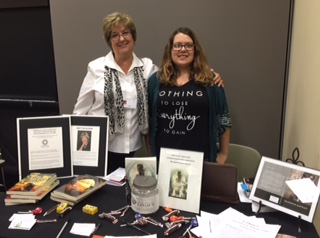
CLAREMONT, Calif. - Oct. 2, 2016 - PRLog -- No one expected the youngest novelist at the Inlandia Indie Book Fair to be 12-year old McKayla Gateley. McKayla and her grandmother, award-winning author Wanda DeHaven Pyle, debuted their new novels at the event in Jurupa Valley on Saturday, October 1.

McKayla spent the past year working on her book, CHAOS, a medieval fantasy filled with Gods and demons, each intent on taking over the land. An avid reader of fantasy and adventure stories, she became fascinated by ancient Greek and Roman mythology during a study of ancient history in school. She plans to release her book on Amazon in December in time for the holiday season. She is already at work on the next book in her series.

When asked who influenced her most in her quest to become a published author, she cited her family and especially her grandmother. However, she has aggressively sought out the advice of teachers and other young adult authors whose work she admires.

"McKayla is a very promising young author," stated her grandmother, Wanda DeHaven Pyle. "I helped her with some editing and formatting, but the story is her own." With a grandmother's pride, she added, "I'm quite sure she will someday win the Pulizer!"

Watch for the release of McKayla's book on Amazon in the near future. Pyle's books are available on Amazon and Kindle at http://amazon.com/author/wandapyle
#PoweredByIndie

Contact
Wanda DeHaven Pyle

Friday, September 16, 2016

I Am Woman!

A new social movement took center stage in the 1970s. It followed the lead of the civil rights movement, as well as the mounting protests against the Vietnam War. In this volatile era, the women of the nation were determined that their voices be heard above the din of discontent.

The women's movement of the '70s was in part a reaction against the type of happy homemaker that was often portrayed in television sitcoms of previous decades. Like it or not, girls growing up in the '50s would have been exposed to role models such as the housewives in Leave It to Beaver, The Donna Reed Show and Father Knows Best, women whose career goals were getting the kids off to school and serving dinner on time. A working woman as role model didn't come along until the late 1960s and early 1970s when shows such as  Julia--where Diahann Carroll starred in the first nonstereotypical network TV role for an African-American woman as Julia Baker, a single mom who worked full time as a nurse--and The Mary Tyler Moore Show in which Moore portrayed Mary Richards, a career-oriented single woman who is a news producer for a TV station in Minneapolis.

For many women, this change in viewpoints created a conundrum regarding long-held beliefs about a woman's role in both the home and workplace. They were caught between their desire to nurture and create a safe haven for their families and the desire to move beyond the confines of a life centered only on home and family. As they stepped forward into this new role, many were hindered by their own naivete regarding the politics and difficulties of surviving in a world that had previously been restricted to "men only." This is the feeling I have tried to capture in The Steel Canyon Legacy.

Tuesday, August 30, 2016

Award for WINDBORNE

I am excited to announce that Windborne has been named an Award Winning Finalist in the Bookvana Awards for "Fiction: Historical".  Check out the official Press Release here.


Get your copy of Windborne today at http://www.amazon.com/-/e/B00GDJ9HTM.

Sunday, August 14, 2016

Summer on the Farm -1960's

Summers on the farm were a far cry from summers in Los Angeles.  There were no lazy days at the beach or sun tanning by the pool. Summers were the busiest times on the farm.  They were hot, dirty and long. The days started at sunrise and sometimes didn't end until after sunset. 

Wheat harvest brought especially long days.  We were always slaves to the weather. When the wheat was ready, it was a race against time to get it harvested before the rains knocked it all flat and made it impossible to get into the fields. Once the combine dumped its load into the truck, it had to be hauled to town and stored in the huge bins at the elevator in town until you were ready to sell it. I started driving truckloads of wheat to the grain elevator when I was 14. The old farmers would lean against the pop cooler drinking grape Nehi and gossip while their loads were weighed and stored. When it was all finished, we had to rush back to the fields to be ready for the next load.

Haying season was the worst! Some of us girls would rake hay in our bikinis just to get a suntan.  You could always tell because the back of our legs were still winter white while the rest of us was cherry red.  Bucking bales was the worst.  Since there were no boys in our family, the job of catching and stacking bales on the wagon usually fell to me.  I would stand on the wagon as it moved slowly through the rows and catch the bales my dad threw up to me. Then I would stack them like bricks as high as I could before the load started to tip.

Back at the barn, I was relegated to the loft where there was no sign of a breeze and the air hung heavy with dust and dried leaves. Dad would unload the bales onto the loader and I would catch them as they came off and stack them in the loft. The alfalfa hay stuck to my sweaty skin and itched like crazy. The prairie hay sliced into my arms like thousands of tiny blades, so I had to wear long sleeves to protect myself.

If I was lucky enough to have a date on weekends, he usually showed up late having just come in from the fields himself. We would go into town and get a coke at the Giant Hamburger, cruise Main a couple of times, and head for home since we both had to get up early the next day.

I wish I could say that I missed those days, but to be honest, I much prefer lazy days at the beach and sun tanning by the pool.

Monday, July 18, 2016

COMING IN SEPTEMBER, 2016

Beta copies are out to readers. Final proof is in the works. Watch for the release in September, 2016!


Something was terribly wrong in the 1970’s. In some ways the decade was a continuation of the 1960’s.  In other ways, however, it was a repudiation of all that gone before. The American character had changed. For Tessa Kingsley and her family it was a decade of tears and triumph.

Finding herself alone and responsible for her two sons and an aging mother, Tessa must navigate her way through a world filled with fragmentation and skepticism. Tessa’s journey takes her through the glittering nightlife of Miami, Chicago, and Las Vegas.  But, ultimately, she is unable to escape the demons from the past that follow her. She soon finds herself drawn into a world of drugs, gambling and mob vengeance before she finally finds the strength to break free. In the process she also discovers her own sensuality and individuality.  It’s a legacy she will pass on to her children in the years to come.

The Steel Canyon Legacy is a gritty and poignant reminder of a lost decade. It is filled with passion and intrigue, and the divergent story lines will keep the reader guessing until the very end.

Saturday, July 2, 2016

Confessions of a Teenage Wallflower

Like most teenagers, I struggled to find my identity. I was somewhat tall and gangly with a slight overbite and a too-narrow forehead to be considered really pretty. My hair was an unruly mass of dark waves that stopped growing just below my shoulders and ended in split ends. I knew I wasn't a real beauty, but I considered myself passably attractive. My grandmother made sure that I started each school year with a new outfit and a new pair of black shoes. Christmas brought underwear and another new outfit, and then I usually got another new dress and a pair of white shoes for my birthday in April. It wasn't high fashion, but I thought I dressed pretty well.

I rode the bus to school until I was old enough to drive the old Studebaker pick-up into town on my own. I played in the band and participated in whatever extracurricular activities were open to girls in my small country school. I even held class offices. (I should probably note here that there were only 15 students in my class, so we sort of passed this duty around each year.)

But I still felt like an outsider.

At a time when most of my friends were beginning to pair off at school dances, and go to parties, I was usually not invited. Some of my friends felt bad about leaving me out so they would invite me to a party and hand me a broom to dance with on the slow tunes. At one "sweet sixteen" birthday party, the host tried to mix things up by having all the girls place their shoes in the center of the room and the boys had to pick a shoe to find their partner for the next dance. This was supposed to ensure that every girl got chosen.  When all the shoes were retrieved and I was still waiting to be collected by my partner, it became clearly evident that I was going to sit this one out.  The host's father finally took pity on me and asked me to dance. I tried to pretend it didn't matter, but inside I was crying.

Like most teenagers, I longed to fit in with everyone else.

I have carried some of these feelings with me into adulthood.  Although, my life is good and I have achieved a modicum of success, I still struggle with feelings of inferiority. The fear of being the last one chosen is always there in the background. But what I've learned is that there are more of us out there than I originally thought.

As a teenager, I felt alone and abandoned. As an adult, I believe that no matter how successful we are, we all harbor some of those same feelings.  It's what drives us to achieve and succeed. It's also what dooms us to failure if we succumb to it.

This is the underlying conflict that all my characters must struggle with.  Whether they succeed for fail, determines the outcome of the story. It is also the unifying characteristic that I hope my readers will identify and connect with. If literature is the mirror we hold up to life, it should reflect not only our hopes and dreams, but also those secret feelings we hold closest to our hearts.

Saturday, June 18, 2016

Windborne, by Wanda DeHaven Pyle

The windswept Flint Hills of Kansas promised bountiful wildlife and fertile valleys, but for Virginia, Helen and Leah it was an empty promise. Dreams here often withered and died from starvation or the harshness and unpredictability of the climate. Eventually, each woman must face the decision to set aside her own hopes and dreams in the struggle to maintain home and family against impossible odds.

Skillfully creating compassionate characters with a range of emotions, Windborne is a novel unique in style and scope.  Set against a historical backdrop of major economic and cultural changes of the past century, it is an elegantly timeless tale about the nature of love, love and awakening.


“Heartfelt and at times quietly moving, this memoir-like work of fiction uses the tapestry of one family in the Flint Hills of Kansas and their struggles, triumphs and tragedies over decades to paint a portrait of a country as it grows and changes with the world around it. Wanda DeHaven Pyle uses a fast-flowing narrative more than dialog to cover much ground within only a few chapters or pages, yet there exists an intimacy, as though we the reader are being offered a view from heaven of this particular family and the decisions which shaped their future and those of successive generations.” – Bobby Underwood, author of the Matt Ransom series of novels