Friday, January 5, 2018

Reflections Of An Aging Parent

I've taken a break from blogging recently to focus on the third book in my Legacy Trilogy. This work represents the final chapter in the saga of the Kingsley family. In this book, I am focusing on the change in the relationship between Tessa and her two sons as they mature and become independent adults. The book has, at times, been difficult to write because much of it has caused me to reflect on my own relationship with our adult children.

I was watching one of those animal shows on TV the other day and I was struck by the similarities we all face as parents: the push-pull relationship between a mother's instinct to protect and nurture her young and the desire to teach them to be independent. It's a dilemma all parents, whether animal or human, must face at one time or another.

When our children are young, they depend on us for everything. For the most part, we freely give up a large portion of our own independence to meet that need for them. The dilemma arises as the child becomes more independent and reaches adulthood. We lose our role as the dominant authority in the relationship and become, instead, equals. If the parent has always relished their role as the primary decision-maker, this can be a difficult, if not impossible transition. Some parents may feel compelled to force the adult offspring to remain as the child in the relationship. This usually fosters resentment and can ultimately destroy the relationship altogether. 

On the other hand, if we have raised independent children, they often go off and make a life for themselves on their own. They make their own decisions and no longer rely on us for advice or guidance. After devoting a good portion of their lives to raising the children, parents can feel abandoned and purposeless. Some will relish the return of their independence and pursue interests that were deferred during the child rearing years. Others will try to insert themselves back into the lives of their children and maintain their previous role. This can impede the growth of the adult child toward independence.

Tessa Kingsley wrestles with this dilemma in The Edgewater Legacy. One of the most difficult things we do as parents is stand on the shore and watch our children as they learn to swim. We pray that the skills we have taught them will keep them from drowning in life's troubles. We try to keep them close to the shore where we can rescue them, but they venture further and further away from us. Ultimately, we must accept the fact that their survival is in their own hands.


Friday, November 10, 2017

Why Must Women Smile More Than Men?

I was blessed by nature with a wrinkle in my brow between my eyebrows. The wrinkle is intensified when I am concentrating or listening intently. Add to this, the fact that my lips do not naturally turn up at the ends. Both of these facial features have been intensified by age and gravity. The result is that my "resting face" often looks as if I am scowling in displeasure, when nothing could be further from the truth.

I wish I had a nickel for every time someone told me I needed to smile more often. Some of my previous employers have even written this into performance evaluations! I wonder how many men have been criticized for this. Clint Eastwood as made a fortune from his scowl and is still (even at his age) considered something of a sex symbol.

Beautiful women who walk the red carpet during awards season, are asked "Who are you wearing?" Men are seldom greeted with this question. More often, they are asked about how they prepared for a film role or how the role impacted their lives or better yet, how they hope the film will impact the audience. A famous actress recently took a talk show reporter to task for asking about her cosmetic surgery instead of the picture she was promoting. The male costar sitting next to her was not asked a similar question.

In the workplace, assertive women are considered pushy and abrasive. Assertive men are considered strong leaders. Men think nothing of interrupting others to contradict or make a point. Woman are taught not to do this. We wait for a lull to add our voices and oftentimes miss the opportunity altogether, leaving our silence to connote passive agreement when the exact may be the case.

But this is not intended to be a treatise against men. It is simply a plea for equality. Women are intelligent human beings with skills and aptitudes that can be applied to many situations. They should never be dismissed as simply bubble-headed airheads that care only about fashion and appearances. But women must take some responsibility for this misconception. If we are silent in the face of this double standard, we have become part of the problem rather than the solution.

Sunday, September 3, 2017

Wisdom from the Aged

My husband is fond of saying "Age brings wisdom whether we want it or not!" How true! How many of us in our elder years wish we had known then what we know now? Here is a case in point.

Recently we were reminiscing on the good years we had experienced in our respective careers. In each case we acknowledged that there had been both good years and bad years. In almost every instance the good years outnumbered the bad years. During the good years, we had supervisors who respected our expertise and supported our efforts. They shared a positive vision for the future. They created strong teams who worked together for the greater good. They cared about the people under their leadership. We felt good about the work we did and the people we worked with.We looked forward to going to work each day.

The bad years were often due to personnel conflicts either with subordinates or supervisors. We struggled with situations, often beyond our control, that caused us to reflect on our integrity and moral conscious. The choice was difficult: face the conflict head on and the consequences that went along with it, or acquiesce knowing that we had surrendered a part of us we could never get back. The situation created stress that we carried over into the workplace and into our homelife. Trust was eroded and collegial friendships suffered. The game became one of survival and "empire building". The spirit of teamwork and collaboration was lost. Workers began to insulate themselves against territory encroachment in an effort to protect themselves. Only the "toadies" thrived in this environment.

So what is the lesson learned from this?  We are not only stronger together, we are happier together. No one builds support through division and  isolation. No one grows taller by tearing down someone else. No one leaves a legacy of positive memories by creating more stress. 

I urge anyone in a leadership position to take this advice to heart. Take stock of the atmosphere you are creating in the workplace. Long after you are gone, you will be remembered not for the accomplishments you can list on your resume, but for the people and lives you touched along the way.

Monday, August 14, 2017

Life in Limbo

Ever feel like you just don't fit in anywhere? I grew up without running water or inside plumbing. We had no phone most of the time and when we did, it was a party line that was tied up with gossipy old crones most of the time. By today's standards, it would be considered a life below the poverty line. When you add a homelife filled with alcohol and abuse, it creates memories of a less than idyllic childhood. Unfortunately, the people we associated with at the time were of a similar status in life.

But I overcame these obstacles to earn advanced educational degrees and move comfortably into the middle class (or what's left of it.) Most of the people I associate with now have never known poverty or abuse. Their memories of childhood are filled with friends, family and pleasant memories. They can sympathize with the less fortunate, but they cannot empathize. They cannot relate to my past anymore than I can relate to theirs.

And yet, when I return to my roots, I am caught in a similar dilemma. I have moved beyond the norms of my childhood. I am no longer a victim of my circumstances, blaming others for my status in life. Education has expanded my worldview along with my moral consciousness. I cannot understand those who cling to their narrow viewpoints anymore than they can understand mine. It's an argument neither side can win. When either side is incapable of rational thought, there is no way to achieve common ground.

But this state of limbo is not unique to my single example. It's a growing trend throughout society. The tragedy in Charlottesville, VA is a prime example.When rational thought is replaced by the emotions of fear and hatred, chaos prevails. Freedom of speech is a constitutional right, but forcing one's views on the opposition and threatening or inflicting harm on those who disagree is not. It's a crime and should be treated as such.

When did education become the enemy?  Why is the nation at war with what is being called "the educated elite"? We are a nation founded on the belief that a free and public education is a constitutional right. And yet there are forces at work in our government that would destroy that right. An uneducated populace is easily ruled by emotional propaganda. They are no longer able to discern fact from opinion. They become puppets to those in power and accomplices to their emotional appeals. Diplomacy is replaced by outward shows of force and violence is inevitable.

Now is the time for a call to action to those who have too long been been silent in the face of injustice and tolerant of radical and irrational thought. But do not mistake a call to action to be a call to arms; rather, it's a call speak out and let your voice be heard.

We are a nation founded on diversity. The words and actions of White Supremacy groups are abhorrent, and those responsible should be condemned in the strongest possible terms. 


Wednesday, July 19, 2017

Battling the Blues

I have the blues.  I feel sad, unloved, and unworthy. I look in the mirror and I don’t like what I see. I look tired, overweight, and frumpy. Maybe I just need a new hairdo, or a new outfit. But I know that won’t change the way I feel about myself. I give myself a peptalk. “What have you got to feel sad about?” I ask myself. “You are a highly educated woman. You have a nice home, a family that loves you, and plenty to eat. Why isn’t that enough?” I have no answer.

I know I’m not alone.  Right now, about 20 million Americans are in the midst of an episode of depression. Some have it much worse than I do. They may have the incapacitating symptoms of what doctors call “major depression.”  These symptoms usually require professional attention because they are very severe and demoralizing. But that knowledge doesn’t stop me from feeling lousy about myself and my life at this moment. I just want to sit on my “pity pot” and feel sorry for myself, but I know that will only make me feel worse. So what to do?

The research indicates that there are several steps I can take to prevent and overcome minor depression.

1. Put some spring in your step.
Regular exercise may be the most powerful natural antidepressant available. It is advisable that you take a brisk walk. Exercise helps generate the release of brain chemicals called endorphins. When endorphin levels are low, depression can seep in. Exercise also oxygenates the brain, keeping it healthy.
How much should you exercise? Thirty minutes, five days a week, at moderate intensity, is a nice level to aim for to help prevent the brain imbalances that can make you vulnerable to depression.
2. Nourish your brain.
Virtually any nutrient deficiency can result in impaired mental function, including depression. To help prevent depression, health experts recommend that people should take high-potency multivitamins or mineral supplements. This will supply the brain with enough nutrients in order to keep it properly functioning and, thus, avoid some mental disorders such as depression.
3. Get enough sleep.
Getting less than eight hours of sleep, night after night, may lower levels of the brain chemical known as “serotonin,” which can make you more prone to depression. To sleep well, health practitioners recommend going to bed and waking up at the same time every day, including weekends.
Relax before bedtime, perhaps with a hot bath. And for the soundest sleep, keep your bedroom quiet and dark.
4. Consider some alternate explanations.
Your emotions, positive or negative, are created not by situations themselves, but by the way you interpret those situations.  A very common situation can turn into a reason for hand wringing unless you take mental steps to prevent it.

All good suggestions, but none of them will work without some serious efforts on my part. Indeed, depression can be very destructive if neglected. Time to get off my “pity pot” and take the first step toward feeling better. After all, I am responsible for my own happiness in life. It’s the one responsibility that I cannot assign to others.


Friday, June 16, 2017

Reuniting the Family of Man

In some families, reunions are a regular--perhaps even annual--event. The majority of family reunions are organized as a means for members to keep in touch with one another. This is especially important if your family, like ours, is spread across the country. Our family gatherings have often been rather sporadically centered around the passing of a beloved family member. Though we try to keep in touch through email or by phone, nothing beats a personal gathering. So, this year, I decided to organize a reunion that would celebrate the birth and growth of our extended family.

It is not uncommon for family members to lose touch with one another, especially if they are not immediately related. The reunion helped us reconnect with long-lost cousins, aunts, and uncles whom we had not kept in touch with over the years. Family bonds were strengthened and relationships were rekindled, reminding us to take a step back out of our busy schedules and remember what is important in life.

We used the occasion to provide a means for younger family members to learn about their heritage by constructing a family tree.  We shared family albums and stories about the past. By including extended family members, we saw how the family tree had grown branches that connected us to others from different religions, different parts of the country and different political ideologies. It helped us to recognize the universality of the human experience.


At a time when our nation is more divided and fractured than any time in recent history, perhaps we all need to reconnect with our pasts and realize that we do not exist in isolation from one another. We are all part of the “family of man”.

Wanda DeHaven Pyle will be reading from her family saga, Windborne, on July 9 at 1:00 at Pipe and Thimble Bookstore, 24830 Narbonne Ave in Lomita California.

Saturday, May 6, 2017

Youth on the Edge


After several weeks off, I am back to work on Book III of the Legacy Trilogy. The Edgewater Legacy follows elder son Christopher to Los Angeles in the 1980s where he pursues his passion for music by landing a job in the music industry as a chart researcher for Silver Bullet Records. He is on the edge of adulthood and struggling to find his moral compass in life. It is a story of greed, graft, and gullibility.

When a naïve young singer overdoses on drugs during a corporate party, Chris and his beautiful co-worker embark on a dangerous journey to expose a blockbuster mentality that deflates artists' careers and gouges consumers with artificially inflated prices. In the process, old enemies resurface and old scars are reopened.

In this new book, I am experimenting with a slight adjustment to the point of view from my earlier work. The point of view in fiction determines whose eyes the reader experiences the story through. In Windborne, I used the third person omniscient or "god" point of view. This assumes that the narrator is all-knowing. The thoughts, feelings, and actions from all the characters may be related to the reader (or they may be withheld). I believe this was a successful approach for Windborne given the scope of the work and the shifting focus of each woman's story.

I continued this approach in The Stone House Legacy and The Steel Canyon Legacy, but I don't believe it was as effective.  Therefore, I have decided to limit the point of view in The Edgewater Legacy. This limits the narrator to seeing into the heart and mind of only one character - in this case, Christopher. This point of view is actually the "default" in fiction. It is the most common because it can be used the most effectively in the majority of situations.

Narrative voice and tone will also be impacted by this point of view. The narrator may take on the manner of speaking, word choice, or dialect of the main character. The tone may reflect the narrator's attitudes and events through the actions and speech of the character, thus affecting the reader's perceptions of the work.

This change in point of view is relatively minor and will probably go unnoticed by most readers. However, it should eliminate some of the confusion around shifting points of view that plagued the first two books in the series.

The Edgewater Legacy is the culminating look at a family impacted by the changing attitudes and mores of the world they live in. Watch for its release in 2018.

Wanda DeHaven Pyle is the author of Windborne and the Legacy Trilogy available now on Amazon and Kindle.

Tuesday, March 21, 2017

Mind Games

Last week I witnessed a women getting run over by a car. 

Although the woman survived the incident with only cuts and scrapes, the image still burns in my mind. I see her look of dismay and her flailing arms at the moment she was hit. I watch as my mind replays the horror of watching the car push her body into the street like some discarded piece of trash. The vision is as clear as if it were happening again right in front of me.

Episodic memory is a person's unique memory of a specific event. It is not completely understood why we remember certain instances in our life while others go unrecorded, but it is believed that emotion plays a key role in our episodic memories. The emotions we experience at the time help to bake the event into our long-term memory so that it becomes more strongly ingrained.

When I was writing Windborne, I found myself drawing heavily on my episodic memory of events that had happened in my childhood. As I wrote, I relived these experiences and was able to describe them in great detail. Writers of psychological thrillers often employ this technique through the use of flashback. Many times the character's motivation is revealed through incidences that resurface in their episodic memory. These memories are often triggered by something they experience in the present that immediately sends them back into the past where they relive the experience for the benefit of the reader.

Episodic memory is unique to each individual. That is why eye-witness accounts often vary. However, the recounting of the memory will often trigger a similar memory in the listener. This tool can be invaluable in producing empathy. It can help the reader identify and sympathize with a character.

Many readers of Windborne have shared that they experienced similar events in their lives or they remember stories handed down through the generations that were similar in nature. This is a key element in all of my writing...to touch the reader's memory and sensitivities so that they can not only appreciate the story, but also experience it.

Wanda DeHaven Pyle is the author of Windborne, The Stone House Legacy and The Steel Canyon Legacy available on Amazon and Kindle at
http://amazon.com/author/wandapyle.

Follow her on Facebook at https://www.facebook.com/wandadehavenpyle


Monday, March 6, 2017

History From a Woman's Point of View

The Zorzi Affair by Sylvia Prince is a historical look at women's struggle for equality and education in a world dominated by men. Set in seventeenth-century Italy during the The Scientific Revolution, the author uses the genre of the historical novel to serve as a commentator on the societal mores of the times. In the 16th and 17th centuries, modern science and the scientific method were born; the rate of scientific discovery exploded; giants such as Copernicus, Vesalius, Kepler, Galileo, Harvey, Newton, and countless lesser figures unlocked world-changing secrets of the universe. Fascinated by the changes, young Zaneta Lucia hungers for more knowledge. Faced with an arranged marriage to an older man who would enhance her families social standing, but doom her to a life without books or learning, she dresses as a boy and strikes out on her own to gain an education.

Her journey is perilous and the reader cannot help but make comparisons to the continued struggles for women's rights to equality. The author uses a limited point of view, to let us inside thoughts and feelings of the female protagonist while shading the male point of view from her perspective. By dressing as a boy, she is able to see first hand the differences between a man's view of the world and a woman's view. Zaneta Lucia is often torn between her "masculine" desire for education and her "feminine" desire for love and acceptance.

In historical fiction, the writer’s relationship with a historical character is less intimate than with a fictional character. There are limits to the author’s authority, so he or she cannot know the character completely. In The Zorzi Affair, the character of Galileo is elusive and far away, so some readers may have difficulty identifying with him.

If you enjoy historical fiction in the vein of Ken Follett's work, you will definitely enjoy The Zorzi Affair. I highly recommend it

Wednesday, March 1, 2017

Celebrate the Power of Women


In the United States, Women's History Month traces its beginnings back to the first International Women's Day  in 1911. In February 1980, President Jimmy Carter issued a presidential proclamation declaring the week of March 8, 1980, as National Women's History Week. The proclamation stated, "From the first settlers who came to our shores, from the first American Indian families who befriended them, men and women have worked together to build this nation. Too often the women were unsung and sometimes their contributions went unnoticed. But the achievements, leadership, courage, strength and love of the women who built America was as vital as that of the men whose names we know so well.
In 1987, after being petitioned by the National Women's History Project, Congress passed legislation which designated the month of March as Women’s History Month. As Dr. Gerda Lerner  has noted, 'Women’s history …is an essential and indispensable heritage from which we can draw pride, comfort, courage, and long-range vision.’ 
As evidenced by the huge turnout for the Women’s March on Washington, awareness of the contributions of women and girls continues to spread and be celebrated throughout the nation.Understanding the struggles of women throughout history will help us to comprehend the need for full equality under the law for all our people.
Celebrate Women's History Month with a free download of The Steel Canyon Legacy. Now through March 5 on Kindle.

The Steel Canyon Legacy

Wanda DeHaven Pyle is also the author of Windborne and The Stone House Legacy.  Follow her on Facebook and Twitter at 

Thursday, February 2, 2017

Dystopian Warnings


The popularity of movies and television shows like The Hunger Games, Doctor Who and The Walking Dead reflect a renewed interest in dystopian themes. Even Orwell’s classic novel, 1984, has seen a spike in sales in recent months. The irony, of course, is how closely these dystopian societies reflect the world we live in.

Let’s begin by examining the meaning of dystopia. Often seen as the direct opposite of utopia, dystopia refers to an imaginary place in which everything is unpleasant or bad. It is typically a totalitarian or environmentally degraded state in which the population is oppressed by corrupt leadership.

In literature, a dystopian society is usually characterized by those beliefs which are contrary to the author’s real feelings. For example, the author may portray a future society where mass poverty, public mistrust and suspicion, a police state or oppression are the norm. The author will then use the story to explore reasons why things are that way as an analogy for similar issues in the real world. Dystopian fiction is speculative in nature and provides a framework for mapping out the future. It extrapolates elements of contemporary society and thus can be read as political warnings.

In dystopian fiction, society itself is the antagonist.  It is society that is actively working against the protagonist’s aims and desires.  This oppression frequently is enacted by a totalitarian or authoritarian government, resulting in the loss of civil liberties and untenable living conditions, caused by a number of circumstances, such as world overpopulation, laws controlling a person’s sexual or reproductive freedom, and living under constant surveillance” (Adams, 2011). The interesting point is that some people within a dystopic society may not recognize or care about their loss of personal freedoms. They have been manipulated into passivity by the oppressive rules of the society in which they live.

In dystopian literature, the story is often unresolved.  The oppression that is tantamount to maintaining control of society is not brought down.  The hero may make a valiant stand against it, but he often fails. However, his attempt gives hope to others. Sometimes the climax is the hero’s escape from the dystopia (e.g. The Giver). Other times the hero fails to achieve anything and the dystopia continues as before.

One cannot help but draw certain parallels between the dystopian societies of literature and the events taking place in the world today. If we are to avoid the dire predictions presented in dystopian fiction, we must take heed of the warning signs present in real life. We cannot afford to be passive observers of the world around us and hope things will eventually work out for the best.  We must take action to preserve those personal freedoms we hold most dear.

Wanda DeHaven Pyle is the award-winning author of Windborne, and the legacy trilogy available now on Amazon and Kindle.


Saturday, January 14, 2017

Facebook Wars and the Art of Persuasion

Whatever happened to civility and common decency?  When did it become acceptable to call people names and publicly castigate those who disagree with us? This is not a political commentary, so before you fire off a response on Twitter or Facebook, hear me out. 

Now, more than ever, we must practice tolerance and understanding. We must seek to find common ground for our differences. To do otherwise is to foster a climate of aggression and hate. In an age of technology, we must remember that words without the benefit of gestures, intonation, a smile or a wink, can easily be misconstrued. Therefore, we must choose our words carefully. There is no substitute for a face to face meeting where ideas can be shared and debated openly and without rancor. 

Our country was founded on the premise of diversity and acceptance. Our forefathers did not agree on everything, but they debated both sides and sought consensus and common ground on which to build our nation. Limiting the defense of one's position to 150 characters on Twitter does not allow for the building of a logical base for discussion. Instead, it only stokes the emotions of dissent. Arguing with strangers on Facebook, when you don't know the circumstances of their argument is futile.

That is not to say that one should never express an opinion in writing, However, one should be prepared to provide solid and substantial evidence in support of that argument. No one wins or is convinced by an argument based solely on emotions. Only the facts can convince someone to change their minds.  If those facts are absent or false, there is no argument. 

I am not naive. I know that sometimes even the facts are not enough to move someone whose beliefs are solidly ingrained. In that case, it's best to recognize the futility of the effort and move on. Save your energy for those who are willing to listen to reason and critically weigh the evidence.

At no time in history has there been a greater need to teach the skills of debate and critical thinking in our schools. This does not mean that educators should take sides in the debate. They should simply teach the art of persuasion as a tool for success in the workplace and in life. At some point, our children will need to convince a superior of an idea that may be different from current practice. They will need these skills to make their case.

But perhaps most importantly, our children need to be able to recognize and analyze the difference between truth and propaganda, even if the adults do not. Our future depends on it.

Wednesday, December 28, 2016

In Praise of Nasty Women

Have you seen those "Nasty Woman" shirts that became popular during the election? While the original remark was intended as a negative comment against a woman who dared to enter the world of "good old boys" and fight for what she believed in, many women have taken up the phrase as a badge of honor.

Why is it that strong women who display some of the same characteristics that are admired in male leadership are considered "nasty" when they are seen in a woman? Throughout time, women have been expected to take a subordinate role to men. They were considered too emotional or too weak minded to understand the complexities of the male world. Of course, women today consider this view of a woman's role outdated and insulting. 

In the not too distant past, single women were expected to find a husband to provide for them as quickly as possible.  In return, the woman's role was to manage the household and raise the children. I can still remember being told as a young wife who dared to express a political opinion,  that "women should stick to their sewing circles!"  I was also told that the only reason a woman needed to go to college was to find a husband. God help us if we suddenly became single mothers!  If our husbands had not left us financially solvent, too bad!  We were expected to quickly find another man or manage on our own - quietly, without making our plight ruffle the feathers of the existing norms.

At first, I tried to comply...to fit the role that was expected of me.  But that shoe didn't fit. Eventually, I rebelled against a role I found stifling and demeaning...I became a "nasty woman."

In our defense, I don't think any of us really enjoy being nasty.  We felt forced into the role in order to make our voices heard. So it is not without a certain sense of pride that we wear the badge of "nasty women." We have worked hard to get to this point.  We are not going to give it up without a fight.

In The Steel Canyon Legacy, Tessa Kingsley is faced with the same dilemma. Can she find a balance between the life that is expected of her and the life she expects of herself?

Wanda DeHaven Pyle is the author of Windborne and the Legacy Trilogy.  Follow her on Facebook and Twitter at 

Tuesday, December 20, 2016

New Blog

Dear Reader,

Thank you for following "School Marms and Cowboys".  I have recently started a new blog at https://wandadehavenpyle.wordpress.com/ that will focus on promoting other independent authors.  I will feature a monthly interview with an author as well as other postings related to the art and craft of writing.

I will continue to post personal reflections on life and living at this site for those of you who enjoy that sort of thing. I will also keep both site updated regarding any new releases I have so you will be the first to know. Thanks again for your support.

Wanda DeHaven Pyle

Thursday, December 8, 2016

Sex, Drugs, and Rock 'n' Roll

The year was 1969.  I was a sophomore at a small teachers college in Kansas.  But even there, the metallic stains of Iron Butterfly's In-A-Gadda-Da-Vida could be heard echoing through the halls. It was the summer of love. In August, more than a half a million people descended on a field near Woodstock, New York for four days of rain, sex, drugs and rock 'n' roll. I wasn't there, of course, but I felt the vibe nonetheless.

Nixon was inaugurated as president and the "Vietnamization" of Southeast Asia began. The youth of American were fed up with the "establishment". There were protests on college campuses. Sit-ins, walk-outs, and love-ins heralded the theme of "Make Love, Not War!" We were ready and willing to rebel to change the status quo. It was all terribly exciting and we all thought we were doing something daring by going against the views of our elders.  The more they tried to suppress us, the louder we became.

But then, we grew up.  We became complacent.  We joined the very establishment we had once protested against. We went to work, got married, started families and disappeared into the ranks of the middle class. The once proud and loud "boomer generation" grew silent.

We're older now...grandparents who have set aside the foolishness of our youth. But was it really foolish? It was our generation that pushed for Civil Rights and began the movement for Gay Rights. We championed women in the workforce and pushed for equal pay. We shook things up.

Maybe it's time to shake things up again. Somewhere beneath the expanded waistbands and the grey hairs beats the heart of a "boomer" who thought they could make a difference.

There is still time.

Wanda DeHaven Pyle is the author of Windborne and the Legacy Trilogy.  Follow her on Facebook and Twitter at 


Wednesday, November 9, 2016

Enter the Antihero

The social turmoil that the entire world as a community has been facing recently has disposed us to be skeptical of almost everything. As skeptics, we are accustomed to deliberation, evaluation of evidence, and the insistence upon extraordinary evidence in support of extraordinary claims. These traits are not important to the political process, which instead rewards appeals to emotion and the successful manipulation of human passion. It is no wonder that we skeptics are uncomfortable in the political world. It represents everything we reject in our search for understanding.

Enter the antihero. He may not really have any good or useful characteristics, but his character is a perfect example of the struggle that we go through in our daily lives when choosing between good and evil. One example of the antihero in literature is Gollum in J.R.R. Tolkien’s Lord of the Rings. The good side of him warns those who want the ring, but the dark side of him is infected by greed and makes him do evil things to obtain the ring. This eventually leads to his death.

If used skillfully, an antihero is much more interesting that the more traditional hero. He is represented as an amalgamation of both good and evil.  These darker heroes can be jerks, pathetic, hard, jaded, or mean. They can be used to represent many things at the same time, such as, social flaws, human frailties and political culture. Instead of having two different people represent two opposing extremes, an antihero combines both into one person and thus presents a more accurate and complete picture of human nature.

The character of Thomas Silverton has emerged in the first two books of my Legacy series with all the potential to become a bona fide antihero. He is selfish, ambitious, manipulative, prejudiced and morally corrupt.  But there is something about him that makes us think there is some redeeming quality there somewhere down deep inside him that will save him. We just haven’t seen it yet.  It’s what gives us hope. Perhaps it will show up in the final book of the trilogy.


Wanda DeHaven Pyle is the award-winning author of Windborne, The Stone House Legacy and The Steel Canyon Legacy. Her books are available on Amazon and Kindle at

Follow her on Facebook at https://www.facebook.com/wandadehavenpyle and Twitter at https://twitter.com/pyle_wanda  


Monday, October 24, 2016

HOLIDAYS: The Good, The Bad, and The Ugly

It's that time of year again. I can already feel the stress mounting as the year winds to a close and the holiday season approaches. 

The GOOD news is that even in this contentious election year, there is a sense of relief that it will soon be over. People will once again be able to have polite conversations without fear of stepping on someone's political toes. I am confident that we will return to a sense of good will toward others. We will smile and wish each other holiday greetings. We will feel triumphant when we find the perfect gift for someone we love. We will delight in the wonder of the season as we see it through a child's eyes.

The BAD news is that the world is still filled with too much sadness and suffering.  There are still children who will not receive a present.  There are families who will not have shelter or food.  There will be missing places at the holiday table for loved ones who have passed on. Charity donations increase during the holidays, but it is only a temporary fix -- a band aid to a much larger problem.

The UGLY news is that, for some, the stress of the season will prove to great to bear. The tingle and lilt of holiday music is a constant reminder of their shortcomings. Suicide and divorce rates tend to increase during the holidays.  Some will escape into binge drinking or drugs in the hopes that when they sober up, the world will have returned to some semblance of normal. Mental health facilities cannot hope to cope with the vast amount of those needing help.  Some may never come forward until it is too late.

My wish for you is that everything that is GOOD about the season is magnified ten-fold, and that there is enough good will in your heart to carry you through in the months after the decorations are gone and the presents are put away. Be mindful of the BAD and the UGLY and continue to look for ways to reduce the stress of the season for those who struggle. Reach out with the hand of fellowship to those less fortunate-- not just during the holidays, but everyday.

Wanda DeHaven Pyle is the author of Windborne, The Stone House Legacy and The Steel Canyon Legacy. Her books are available on Amazon and Kindle at http://amazon.com/author/wandapyle


Wednesday, October 5, 2016

Story-Telling and Writing is a Family Affair

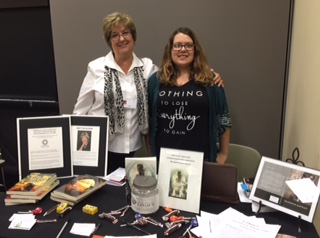
Grandmother and Granddaughter Share Spotlight at Inlandia Indie Book Fair
Inlandia Indie Author Fair-October 2016
CLAREMONT, Calif. - Oct. 2, 2016 - PRLog -- No one expected the youngest novelist at the Inlandia Indie Book Fair to be 12-year old McKayla Gateley. McKayla and her grandmother, award-winning author Wanda DeHaven Pyle, debuted their new novels at the event in Jurupa Valley on Saturday, October 1.

McKayla spent the past year working on her book, CHAOS, a medieval fantasy filled with Gods and demons, each intent on taking over the land. An avid reader of fantasy and adventure stories, she became fascinated by ancient Greek and Roman mythology during a study of ancient history in school. She plans to release her book on Amazon in December in time for the holiday season. She is already at work on the next book in her series.

When asked who influenced her most in her quest to become a published author, she cited her family and especially her grandmother. However, she has aggressively sought out the advice of teachers and other young adult authors whose work she admires.

"McKayla is a very promising young author," stated her grandmother, Wanda DeHaven Pyle. "I helped her with some editing and formatting, but the story is her own." With a grandmother's pride, she added, "I'm quite sure she will someday win the Pulizer!"

Watch for the release of McKayla's book on Amazon in the near future. Pyle's books are available on Amazon and Kindle at http://amazon.com/author/wandapyle
#PoweredByIndie

Contact
Wanda DeHaven Pyle

Friday, September 16, 2016

I Am Woman!

A new social movement took center stage in the 1970s. It followed the lead of the civil rights movement, as well as the mounting protests against the Vietnam War. In this volatile era, the women of the nation were determined that their voices be heard above the din of discontent.

The women's movement of the '70s was in part a reaction against the type of happy homemaker that was often portrayed in television sitcoms of previous decades. Like it or not, girls growing up in the '50s would have been exposed to role models such as the housewives in Leave It to Beaver, The Donna Reed Show and Father Knows Best, women whose career goals were getting the kids off to school and serving dinner on time. A working woman as role model didn't come along until the late 1960s and early 1970s when shows such as  Julia--where Diahann Carroll starred in the first nonstereotypical network TV role for an African-American woman as Julia Baker, a single mom who worked full time as a nurse--and The Mary Tyler Moore Show in which Moore portrayed Mary Richards, a career-oriented single woman who is a news producer for a TV station in Minneapolis.

For many women, this change in viewpoints created a conundrum regarding long-held beliefs about a woman's role in both the home and workplace. They were caught between their desire to nurture and create a safe haven for their families and the desire to move beyond the confines of a life centered only on home and family. As they stepped forward into this new role, many were hindered by their own naivete regarding the politics and difficulties of surviving in a world that had previously been restricted to "men only." This is the feeling I have tried to capture in The Steel Canyon Legacy.

Tuesday, August 30, 2016

Award for WINDBORNE

I am excited to announce that Windborne has been named an Award Winning Finalist in the Bookvana Awards for "Fiction: Historical".  Check out the official Press Release here.


Get your copy of Windborne today at http://www.amazon.com/-/e/B00GDJ9HTM.